|
Lomont
Family History
|
 |
|
Geography
And History Of The Franche-Comté Region
|
||
|
|
|
Feedback - Send email to Don Lomont
|
|
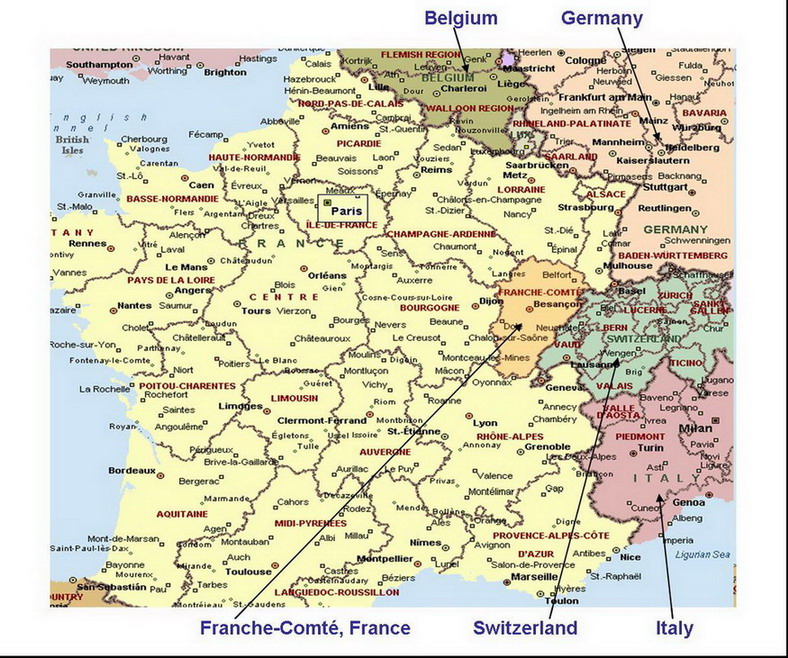
Ancestors of the Lomont Family that settled initially in Besancon, Indiana emigrated from the Franche-Comté Region of France in 1850. The name Lomont appears in many places in the Department of Doubs, Franche-Comté region of France. |
|
|
The Franche-Comté region of France has been inhabited since the Paleolithic age. The Celtic people living in Gaul, the region roughly corresponding to what is now France, Belgium, Switzerland and Northern Italy, from the Iron Age through the Roman period were known as the Gauls. The Franche-Comté region was occupied in the 4th century B.C. by the Sequani, a Celtic tribe. They mostly spoke the Continental Celtic language called Gaulish. Sequani, in ancient geography, were a Gallic people who occupied the upper river basin of the Arar (Saône), the valley of the Doubs and the Jura Mountains, their territory corresponding to Franche-Comté and part of Burgundy (Bourgogne). The Franche-Comté region became a part of the Roman Empire after Julius Caesar's victory over the Gauls in 52 B.C. The dominant language of the region became Vulgar Latin from the Roman Empire. Little touched by the Germanic migrations, it was part of the territory of the Alamanni in the 5th century. Later, when Rome was no longer able to afford protection to the inhabitants of Gaul, the Sequani became merged in the newly formed Kingdom of Burgundy then known as the Burgundians from 457 to 534. It was Christianized through the influence of St. Columbanus, who founded several monasteries there. In 534, it became part of the Frankish kingdom. In 561 it was included in the Merovingian Kingdom of Burgundy, under Guntram, the third son of Clotaire I. In 613, Clotaire II reunited the Frankish Kingdom under his rule and the region remained a part of the Kingdom of Burgundy under the later Merovingians and Carolingians. |
|
|
The various small countships of the area were united to form the county of Burgundy, a fief of the kingdom of Burgundy from 888, the province becoming subject to the Holy Roman Empire in 1034. The name Franche-Comté (English: Free County of Burgundy, or literally "Free County") did not officially appear until 1366. In 1384, Franche-Comté passed through marriage to Philip the Bold, duke of Burgundy, under whom it received a definite political organization — council, estates, parlement — centered in Dôle. As a result of dynastic marriages, it was separated from the neighboring Duchy of Burgundy upon the latter's incorporation into France in 1477. That year at the Battle of Nancy during the Burgundian Wars the last duke, "Charles the Bold", was killed in battle. It was transferred to Austria in 1481 and ceded to the Habsburgs in 1493 by the Treaty of Senlis. After the reign of Emperor Charles V, it passed in 1556 to the Spanish branch of the Habsburgs. Under Spanish rule the province fared well and was granted a large measure of autonomy. The parlement of Dôle was the political center, and the governor was chosen from the ranks of the Franche-Comté nobility. Moreover, the obligatory money payment to Spain was small, and few of the province's inhabitants were taken as soldiers. Franche-Comté's prosperity was symbolized by Besançon's fairs and the many new Renaissance structures built. Franche-Comté was often invaded by the French and was devastated during the Thirty Years' War. Spain forcefully defended the region, no doubt because of its military importance; it not only connected the Spanish possessions in Italy and the Low Countries but also allowed for the opening of another front against France in case of war. In 1665, however, Louis XIV laid claim to Franche-Comté in the name of his wife, Maria Theresa, and three years later the Prince de Condé conquered it in 15 days. Louis swore to maintain the province's liberties but was forced to return it to Spain by the Treaty of Aix-la-Chapelle. Another successful invasion was staged shortly afterward; both the king and the fortification expert, Vauban, were present at the lengthy siege of Besançon in 1674. The arch of Saint Martin's Gate in Paris was erected to celebrate Franche-Comté's definitive annexation by France in 1678 by the Treaty of Nijmegen. |
|
|
Franche-Comté was one of the last parts of France to have serfdom*. In 1784, half the population were serfs, 400,000 out of the 1 million French. Landowners took 1/12 of the sales price if a serf wanted to sell up. Serfs were not forced to stay on the land, but the lord could claim “droit de suite”, whereby a peasant who died away from his holding left it to the lord, even if he had heirs. A runaway serf's land was forfeit after ten years. Louis XVI issued a decree banning these practices on August 8, 1779 but the parliament of Besançon blocked this till 1787. The region's population fell by a fifth from 1851 to 1946, reflecting low French natural growth and migration to more urbanized parts of the country. Although Besançon, the new capital of the province, was given a parliament and a university, anti-French sentiment remained strong until the 18th century, when Frenchmen from surrounding districts began to settle there. In 1790, as part of the administrative reforms brought about by the Revolution, the old province was divided into departments. Franche-Comté was resurrected as an administrative region in 1982. |
|
| * Serfdom is the status of peasants under feudalism. It was a condition of bondage or modified slavery which developed primarily during the High Middle Ages in Europe and lasted to the mid-19th century. Serfdom included the labor of serfs occupying a plot of land owned by a lord of the manor in return for protection and justice and the right to exploit certain fields within the manor to maintain their own subsistence. Serfdom involved not only work in the lord's fields, but his mines, forests and roads. The manor formed the basic unit of society and the Lord of the Manor and his serfs were bound legally, economically, and socially. Serfs were laborers who were bound to the land; they formed the lowest social class of the feudal society. Serfs were also defined as people in whose labor landowners held property rights. The era of the French Revolution (1790s to 1820s) saw serfdom abolished in most of Europe. Serfdom was formally abolished in France on August 11, 1789 with the "Decree Abolishing the Feudal System". This decree abolished the manorial system completely. It abolished the authority of manorial courts, outlawed pigeon houses, eliminated and altered tithes (set taxes), and freed those who were enslaved. The majority of the population consisted of peasants. This social system was no longer viable. | |
 |
|
Franche-Comté Region Today |
|||||||||||||||||||||||||||
 |
|||||||||||||||||||||||||||
|
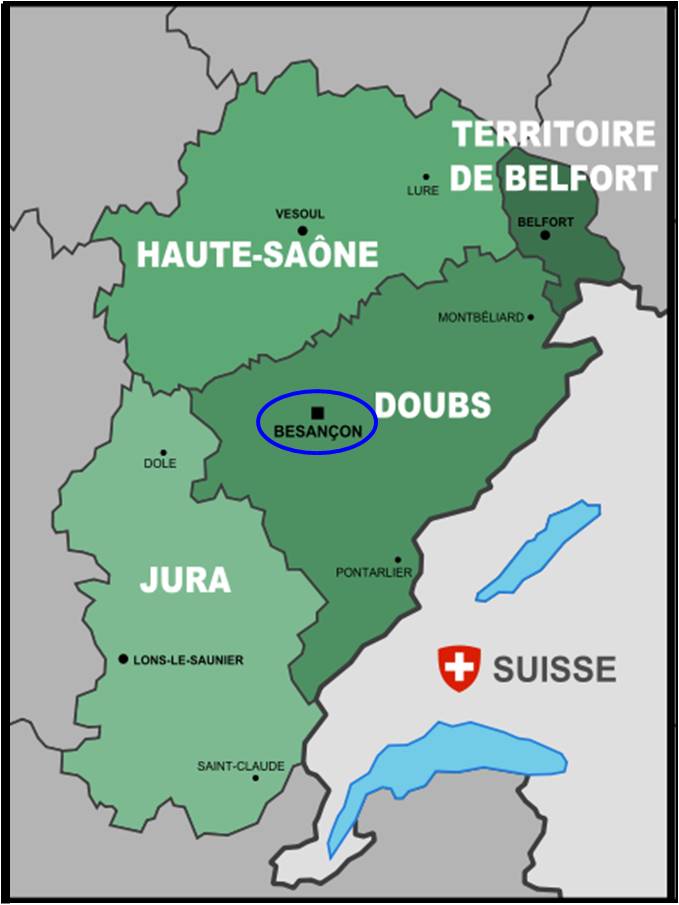
The Franche-Comté Region, located in Eastern France along the border with Switzerland, is composed of the modern departments of Doubs, Jura, Haute-Saône and Territoire de Belfort. Franche Comté has a population of 1,159,000 (2008). Besançon is the capital of Franche Comté. The Franche-Comté Region lies between the Vosges range of mountains to the north and the Jura (Gaulish word meaning 'forest') range to the south, the landscape consists of rolling cultivated fields, dense pine forest and remparts like mountains. This little known région which borders Switzerland shares much of its architecture, cuisine, and culture with its neighbor. Forty percent of the région's GDP is dependent on manufacturing activities, and most of its production is exported. Construction of automobiles and their parts is one of the most buoyant industries here. Forestry exploitation is steadily growing and 38% of the agriculture is dairy and 17% cattle farming. The région has a large and lucrative cheese-making industry with 40 million tons of cheese produced each year, much of which is made by the traditional cheese dairies of Franche-Comté. |
|||||||||||||||||||||||||||
|
Franche-Comté
Region
|
|||||||||||||||||||||||||||
 |
|||||||||||||||||||||||||||
|
Franche-Comté
Churches Have A Unique Architecture
|
|||||||||||||||||||||||||||
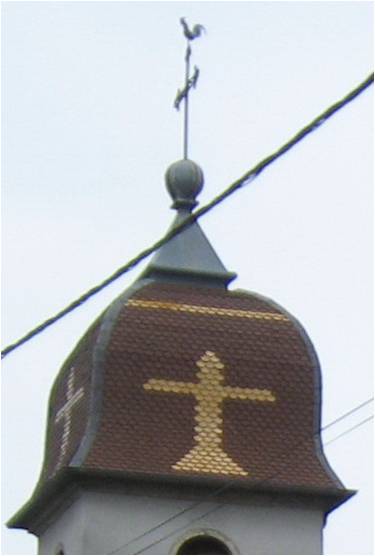
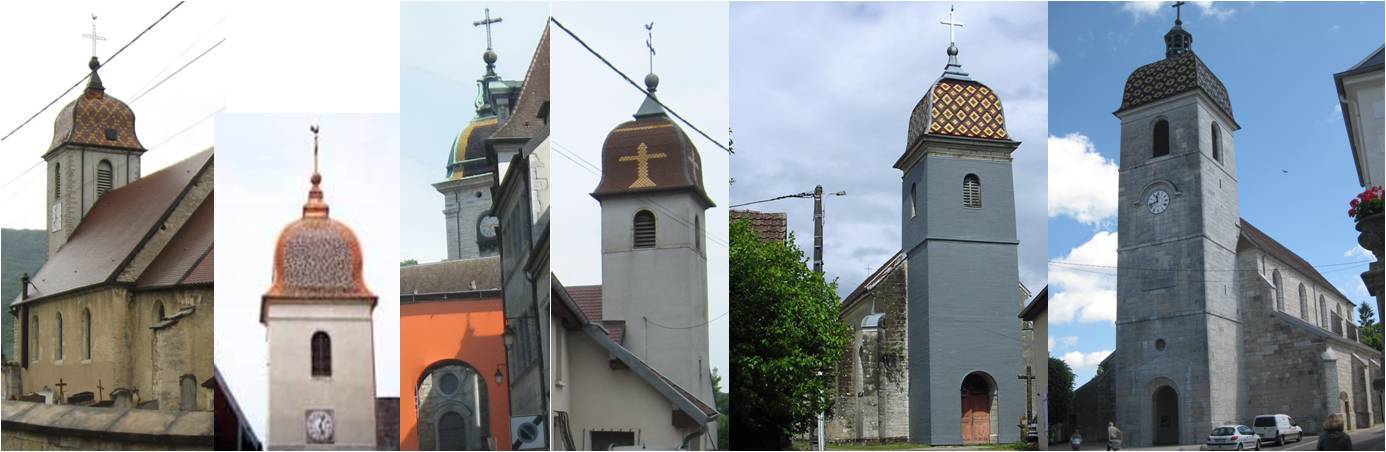
| Churches of the Franche-Comté Region have a “Clochers Comtois” bell tower architectural style unique to this area. The curved dome of the church bell tower is unique to Franche-Comté. The graceful domes on these bell towers are sometimes decorated with colored tiles to form geometric patterns. There are over 650 clochers comtois within Franche-Comté. The style is said to have reached Franche-Comté from Florence in the 16th century. Much rebuilding was necessary after the French conquest of the region in 1678, and many church domes date back to this period. | |||||||||||||||||||||||||||
 |
|||||||||||||||||||||||||||
|
Branne
|
Clerval
|
Besançon
|
Church of St Pierre, Roche lès Clerval
|
Lomont-sur-Crête
|
Vercel
|
||||||||||||||||||||||
|
This page still under construction,
contributions welcome
|
|
Credits: Donald J. Lomont researched and contributed much of the information for this page. Some of the information was culled from internet search results; Wikipedia and other historical articles.. |
|||