 |
|
Lomont
Family History
|
|
The
Voyage Across the Atlantic - Ship Travel
|
|
|
|
Feedback - Send email to Don Lomont
|
|
The Voyage Across the Atlantic - Ship Travel The simple innovation of sailing on a schedule gave immigrants and the American economy a boost in the early 1800s. Traditionally, ships sailed when they had loaded enough cargo to justify a voyage. Passengers could be delayed days or even weeks waiting for the holds to fill. After the War of 1812, ship owners began experimenting with regular timetables, and the 1820s and 1830s saw a boom of scheduled shipping lines across the ocean and along the coasts. During the period of ship travel of our ancestors, the packet ship and the newer steamships were the primary means of passenger travel. Most emigrants used the reliable packet ships because they were more affordable and readily available than the steam ships who began to compete with the packet ship after 1850. The ship Saint Nicholas on which Claude François Lomont's family sailed was a packet ship. Packet ships carried mail, cargo, and passengers. A typical packet in the 1820s and 1830s could also accommodate 10 to 20 well-to-do cabin passengers. Most passengers, however, crossed in the steerage area, below decks. Conditions varied from ship to ship, but steerage was normally crowded, dark and damp. Space and privacy were both hard to come by. Passengers slept in narrow, closely packed bunks located below deck. During storms, the door was latched closed, leaving passengers with little light or fresh air. The stench of vomit and unemptied chamber pots could be overwhelming. Constant jousting about from weather and waves made even standing difficult on many days. On the worst days, passengers could not even stay in their beds to sleep, but went sliding about the cabin. Limited sanitation and stormy seas often combined to make it dirty and foul-smelling. Rats, insects, and disease were common problems. Many emigrants probably did not look back on their ship voyage with fond memories. This quote from Ralph Waldo Emerson sums up the voyage. "The road from Le Havre to New York, as they who have traveled it well know, is very long, crooked, rough, and eminently disagreeable." Rich or poor, many travelers alternated between anxiety and boredom on long ocean crossings, depending on the weather. Life at sea was not all drudgery though. Travelers found time for fun, sometimes dancing on deck, writing letters home, or playing games. Despite the difficulties, many were excited by the adventure and the approach of their new home. The voyage to America was an important and memorable experience. It was not only the changes that arrival in American brought to their lives, but the very trip itself that made a lasting impression on their lives. Claude and family traveled in the steerage area for the long journey according to the manifest. This confirms that they wanted to conserve what funds they had to make sure that they could complete the trip. All or most of the family emigrated to the United States on the ship Saint Nicholas which sailed on March 18, 1850 from Le Havre, France and arrived in America at the Port of New York on April 13, 1850 after a 27 day voyage at sea. Average time to make this voyage for the Saint Nicholas was 38 days, so this would tend to indicate that this voyage had good winds and fair seas. The shortest trip by this ship on this route was 23 days. The Manifest Identification Number for this Atlantic Ocean crossing was 6424. The ship Saint Nicholas typically sailed from Le Havre twice a year to New York but in 1850, it made just this one trip from Le Havre. This ship had its first trip to New York in 1842 and the last trip was in 1860. So when Claude and family traveled, the ship captain was a seasoned veteran of this route to America. |
|||||
|
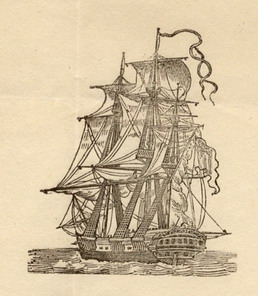
Historical Information About the Packet Ships. The packet ship was the predecessor of the twentieth-century ocean liner. Packet ships sailed between American and European ports on regular schedules. The first packet company, the Black Ball Line, began operations in 1818, with four ships offering a monthly service between New York and Liverpool. By the mid-1820s packets were sailing from American and British ports each week. For the next decade they carried most of the passengers, high-valued freight, and mail that passed between the Old World and the New. The typical packet ship was about two hundred feet long, with three masts and a bluff-bowed hull that, though lacking the speed and grace of the later clipper ship, could plow through the worst North Atlantic seas with reasonable speed and stability. In good weather a packet could make two hundred miles a day. By the late 1830s steamships were beginning to attract lucrative cargoes and wealthy passengers, leaving the sailing vessels to people who could afford nothing faster. In the mid-nineteenth century millions of working-class immigrants from western Europe came to the United States, most of them on board packet ships. Eventually the steamers took over the passenger trade entirely, relegating the packet lines to the hauling of nonperishable freight. The last of the packets sailed in 1881. |
|||||
 |
|||||
|
Typical Packet Ship
|
|||||
|
The United States ship Saint Nicholas was built at New York by Jacob A. Westervelt & William Mackey, and launched in 1841. Details of the ship include a weight of 797 tons; 148 feet x 34 feet 6 inches x 21 feet 5 inches (length x beam x depth of hold). The Saint Nicholas sailed as a passenger ship in John J. Boyd and Edward Hincken's Second Line of packets between New York and Le Havre from 1841 to 1860, during which time her westward passages averaged 38 days, her shortest being 23 days, her longest 63 days. She is said to have burned at New York in 1859, following an explosion,
but this is known to me a mistaken identification as the Mississippi
steamship of the same name, was the actual ship that exploded and
sank at New Orleans in June of that year: the packet ship Saint
Nicholas continued to sail between New York and Le Havre until at
least the outbreak of the Civil War. The last passenger voyage departed
from Le Havre and arrived at the port of New York on September 6,
1860 documented with manifest number 9654. The ship Saint Nicholas with S, Bragdon, master, bound from Le Havre via Portsmouth for New York, in ballast, was lost on Sable Island, off the coast of Nova Scotia, on 16 April 1861. Fourteen members of the crew were saved, but the captain and the remaining eight were lost. Sources: Robert Greenhalgh Albion, Square-riggers on Schedule; The New York Sailing Packets to England, France, and the Cotton Ports (Princeton: Princeton University Press, 1938), pp. 226, 286-287; New York Herald, 24 April 1861. Modified by D.J. Lomont results of internet research. This author has searched many historical books on ships for a picture of the ship Saint Nicholas to no avail. Then happend upon an article about the existence of a model of the Saint Nicholas. Someday, I want to see it and get some pictures. If you get to New York before I do, I would appreciate pictures from several angles. You may need to convince the curator that your ancestors came to America on this ship to get close enough for good pictures. Model of the Ship Saint Nicholas in New York By 1934, Joseph Appleton was working as curator at the Marine Museum of the City of New York, the collection of which has since been inherited by the Museum of the City of New York. In a promotional brochure for the museum listing Appleton as curator, notable yachtsmen Arthur Curtiss James and L. Gordon Hammersley are listed as trustees of the museum. During his tenure there, Appleton built three locally significant models for the museum: the Clermont, the first commercial steamboat that ran from New York up the Hudson River to Albany, built by Robert Fulton; the Halve Maen or Half Moon, Henry Hudson's ship that he sailed from Holland to the New World and then up the river that now bears his name to present-day Albany; and the Saint Nicholas, a packet ship that sailed between New York and Le Havre, France, in the 1840s and '50s. Appleton had acquired enough experience and reputation to have been approached by the President of the United States to repair the chief executive's personal model of the U.S.S. Constitution. FDR's model, built in the 1870s, was in a state of disrepair; Appleton replaced all of the complicated rigging and renewed the mainmast and bowsprit. In a quote from the Brooklyn Daily Eagle on May 4, 1934 Appleton explained, "There were no professional model-makers in the United States 60 years ago when this [U.S.S. Constitution] was made. In Great Britain the Admiralty had fine model-makers, for they found that with well-made models to show members of Parliament they could get bigger appropriations for the navy." The same model appears in the background of a famous portrait of FDR by Ellen Emmett. |
|||||